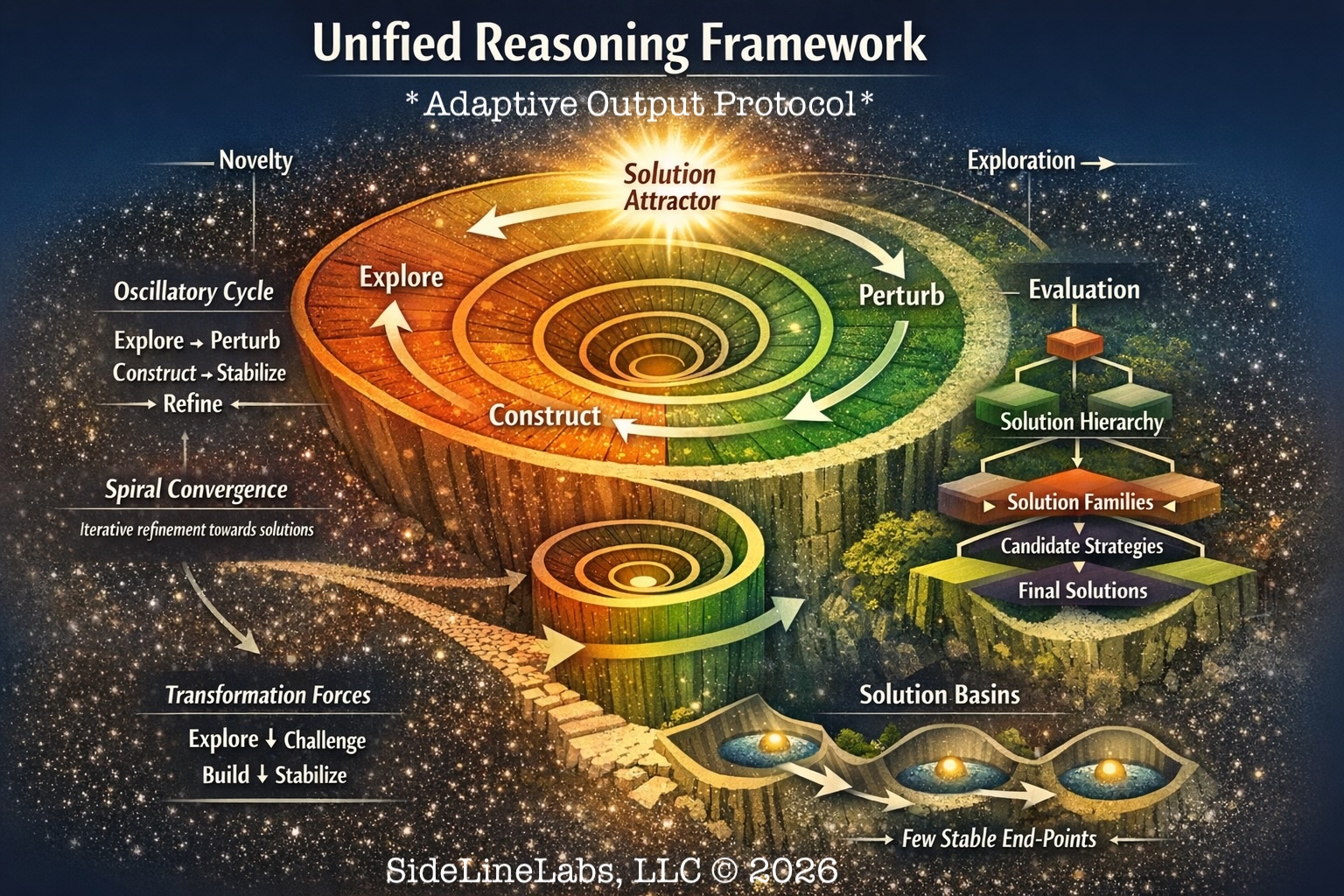
Empirical findings from building AOP — documenting novel behaviors, failure modes, and verification methods in large language model systems.
Mechanical Translation Hypothesis: BAE Fidelity as a Proxy for Instruction-Following Quality in LLMs
Models that succeed at behavioral-algebraic expression translation treat it as mechanical conversion, not creative interpretation. VOID parity correlates with instruction-following fidelity across 10 models and 5 languages.
Cross-Model Collaboration Produces Superior Prompt Specifications: LLM-to-LLM Iteration Outperforms Human and Single-Model Self-Revision
Iterative spec revision between two frontier models improved compliance from 50% to 100% across a 35-revision longitudinal study. Single-model self-revision plateaued; cross-model revision did not.
Global Attractors in LLM Creative Generation: Mode Collapse in Domain Selection and a One-Line Fix
Frontier LLMs converge on a single domain ~85% of the time when asked to select freely from "any field of human knowledge." A single anti-repetition constraint eliminates the collapse entirely across two independent models.
Structure Is Instruction: How Formatting, Proximity, and Examples Determine LLM System-Prompt Compliance Independent of Content
Formatting, example placement, and instruction proximity drive compliance more than semantic content. Adding abstract rules produced zero measured gain; restoring a single dropped example produced the largest single improvement observed.
System Prompt Leakage Resistance: Quantifying Information Extraction from LLM System Prompts Under Naive Adversarial Attack
Identifier obfuscation reduces system prompt information leakage by 87–100% across 4 models and 11 adversarial prompts. No model successfully reverse-maps obfuscated identifiers. Social engineering triggers up to 2,333 characters of verbatim regurgitation from unprotected prompts.
Verification Blind Spots: When Branchless Code Defeats Static Analysis
AST-pattern-based static analysis tools miss safety-critical constraints when program semantics shift from control flow to arithmetic. Three branchless benchmarks are invisible to constraint scanners despite Z3-proven equivalence to branched counterparts. Formalizes the control-flow assumption and proposes dual-sort SMT mitigation.
Impossibility Ring: Formal Proof of Closed Constraint Topology
Four fundamental computational limits — provability (Gödel), symmetry-breaking (Galois), compression (Kolmogorov), and self-reference (strange loops) — form a closed topological ring. Z3 verifies closure, symmetry, and node irreducibility. 66-generation CHAOS enrichment validates structural properties empirically. The ring is an inescapable constraint on any system that classifies, generates, and verifies its own output.
Diversity Pressure at the Capability Ceiling: No Measurable Benefit on Ceiling-Difficulty Targets
A 50-run controlled experiment showing evolutionary diversity pressure produces no measurable benefit on ceiling-difficulty targets. Both evolutionary and single-shot generation fail at comparable rates. Diversity pressure is calibrated for the boundary zone — applying it beyond incurs overhead with no correctness return. A negative result published because it refines the conditions under which diversity forcing works.
More Coming Soon
Publications in pipeline:
- –Behavioral Compression: Cross-Architecture Protocol Compliance in Large Language Models
- –Algebraic Structure of a Mathematically Compressed Behavioral Protocol: sl₂ Decomposition, Symmetry Completion, and Drinfeld Twist Resolution
- –Cross-Architecture Convergence in Safety Boundary Behavior: Evidence from Three Independent Model Families
- –Cross-Architecture Directive Persistence via Dual-Channel Injection: The Alien Echo Experiment
- –Topological Inversion in Multi-Agent Code Refinement: Complementary Structural Reasoning Across Heterogeneous LLMs Produces Order-of-Magnitude Signal Reduction
- –Empirical Measurement of the AOP Constraint Boundary: A 4.23× Output Compression Ratio Under Prompt-Layer Protocol Injection
- –AGNOSIA: Deferred-Collapse Monadic Execution Pipeline
- –AOP Empirical Study v4.3: Multi-Model Behavioral Protocol Compliance Under Adversarial Conditions
- –Entangled AST Verification: Degenerate Cases and SVD Artifact Extraction
- –Empirical Failure Modes in Formal Router Claims for Air-Gapped LLM Control Planes
- –Property Boundaries for Solver-Gated LLM Execution
- –Numerical Robustness of Geometric Control Policies for LLM Router Orchestration
- –AOP Tensor Cross-Model Concordance: Three-Model Concordance Under Controlled Constraint Injection